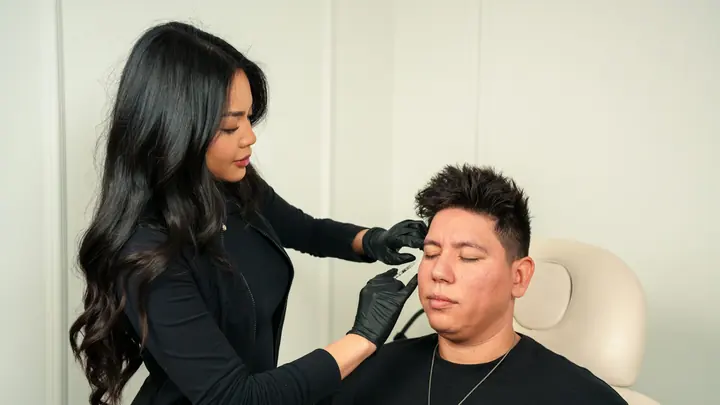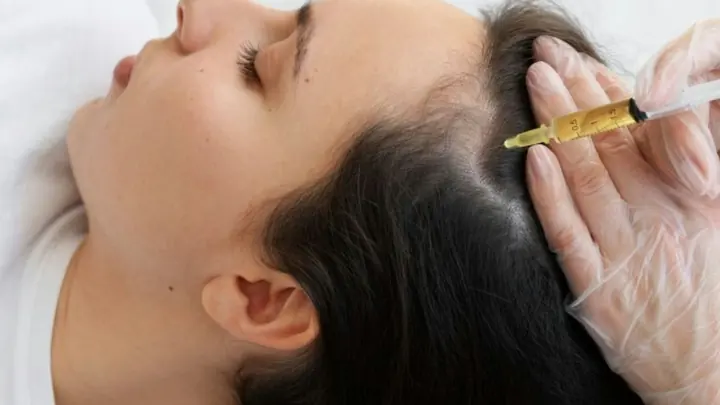
PRP for Hair and Skin: Does It Work, and Who Is It For?
Can platelet-rich plasma help hair loss or skin texture? An honest look at the evidence, who it does not suit, and what a session and aftercare involve.
Read article
Cheek, chin and jawline filler involves injecting a product, usually hyaluronic acid, into carefully chosen places to restore volume the face loses with age or to improve the balance between features, such as projecting a small chin or defining the jawline. A good result looks natural and in harmony with your own face, not a copy of someone else's. Success depends mainly on careful assessment and a doctor who knows facial anatomy well.

With age, the fat pads in the midface shrink and descend slightly, bone volume gradually decreases and the skin loses some of its collagen. The cheeks look flatter, the lines around the mouth deepen and the jawline becomes less defined.
In younger people the aim may be different, such as a small chin that makes the nose look larger in profile, or slight asymmetry between the two sides of the face. That is why a good assessment starts by looking at the whole face from the front and the side, not at one area.
These areas use firmer fillers than lip filler, because they need structural support. The product is often placed in deep layers near the bone, or with a flexible blunt-tipped cannula, depending on the area and the doctor's choice.
Doctors often start with a moderate amount, then review the result at a follow-up visit two weeks later and add a little if needed. This step-by-step approach is safer, gives you time to get used to your new look before adding more, and reduces the risk of overdoing it, which can make the face look heavy or unbalanced.
Results in these areas usually last 12 to 18 months, and sometimes longer, depending on the product, the amount and your body. Hyaluronic acid breaks down gradually, so the face slowly returns to how it was.
An important advantage is that it can be dissolved with an enzyme called hyaluronidase if you do not like the result or a complication occurs. That is why permanent fillers are generally not recommended, as their problems are much harder to manage.
Most side effects are mild and temporary, but some are rare and serious, which is why filler is a medical procedure that needs a trained doctor and an equipped setting:
Choose a licensed doctor in dermatology or aesthetics who explains the plan, shows you the pack of a product approved by the Saudi Food and Drug Authority, and has the dissolving enzyme and a ready plan for complications. Avoid injections in salons or homes, and offers that push you towards large amounts in a single session.
Your doctor may sometimes suggest a better alternative to filler; a bulky jaw muscle, for example, may be treated with Botox, and a receding chin caused by a jaw bone or bite problem may need assessment by a dentist or a maxillofacial surgeon. Filler is not done during pregnancy or breastfeeding, and people with autoimmune conditions or who take blood thinners need a specific assessment.
It may look slightly full in the first days because of swelling, then settles within one to two weeks. A permanently puffy look usually comes from using too much product.
It improves definition and balance in many cases, but it does not treat severe sagging or major jaw bone problems, which may need other options your doctor can discuss.
Most fillers contain a local anaesthetic, and a numbing cream may be used beforehand, so most people feel pressure or tolerable discomfort.
It is usually advised to avoid strenuous exercise for 24 to 48 hours to reduce swelling and bruising.
Seek medical help immediately if, after filler, you develop severe or increasing pain, whitening, bluish or net-like discolouration of the skin, or any change in vision, as these are emergency signs. Increasing swelling with redness and warmth, or painful lumps, also need prompt assessment. If you are considering facial contouring with filler, you can book a consultation at Medical Care Clinics in Al-Shati Al-Gharbi, Dammam, close to Al-Khobar and Dhahran, where our dermatology and aesthetics team will assess your features and discuss a balanced, safe plan.
This article is general health education and does not replace a medical examination. Every case needs its own assessment by a doctor.
Can platelet-rich plasma help hair loss or skin texture? An honest look at the evidence, who it does not suit, and what a session and aftercare involve.
Read articleWhy does beard hair need more sessions, and can laser help razor bumps on the neck? A guide for men on areas, sessions, preparation and side effects.
Read articleSummer humidity in the Eastern Province leaves skin shiny and sweaty, then air-conditioning dries it indoors. Here is a simple, light-layered routine that suits this changeable climate.
Read article