How Often Should You Get a Dental Check-up and Cleaning?
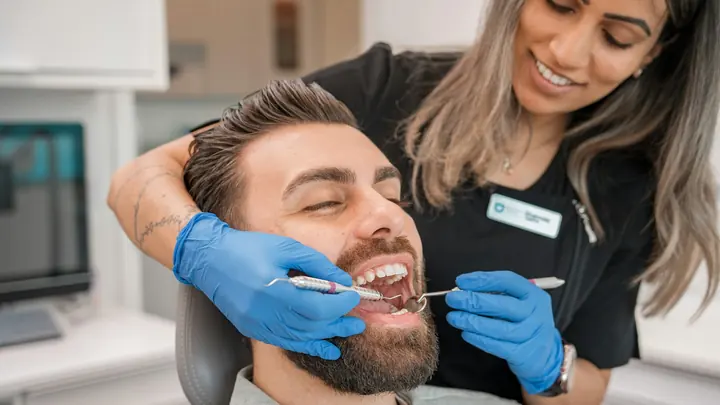
Every 6 months is the common average, but the right interval depends on your gums and teeth. Here is what happens in the visit and how to care for your teeth afterwards.
Read article
Dental care during pregnancy is safe and important, and it is actively recommended. Hormonal changes make the gums more prone to inflammation, and check-ups, cleaning and treating decay can usually be done safely while pregnant, as long as your dentist knows you are pregnant and coordinates with your obstetrician when needed.

Pregnancy hormones make the gums react more strongly to the layer of bacteria on the teeth (plaque), so they become red, swollen and bleed easily when brushed. This is called pregnancy gingivitis. It is common, often starts in the early months and can peak mid-pregnancy.
The good news is that regular care eases it considerably, while neglecting it can lead to deeper inflammation of the tissues that support the teeth. Occasionally a red, fleshy lump called a pregnancy tumour appears on the gum. It is benign and usually disappears after delivery, but a dentist should examine it.
Check-ups and cleaning are fine at any stage. For non-urgent treatment such as fillings, many dentists prefer the second trimester, roughly months four to six, when nausea eases and sitting in the chair is more comfortable.
In the third trimester, lying flat for long periods can be difficult, so visits are kept shorter and your position is adjusted. Cosmetic treatments such as whitening are usually postponed until after the birth. Severe pain, infection or swelling should never be postponed at any stage, because an untreated infection can be more harmful to mother and baby than the treatment itself.
Dental X-rays use very low doses aimed at the mouth, and health bodies consider them safe in pregnancy when needed, with a thyroid collar or abdominal shield at the dentist's discretion. Your dentist will only take them when they are necessary for diagnosis or treatment.
Local anaesthetic used in dental clinics is also generally considered safe. For painkillers and antibiotics, your dentist will choose only those suitable in pregnancy, and all of them require a prescription. Tell your dentist how far along you are and about every medicine you take; your dentist will decide what suits you, coordinating with your doctor when needed. Never take medication on your own.
Frequent vomiting exposes the teeth to stomach acid, which can weaken enamel over time. You may want to brush straight away, but that increases wear because enamel is temporarily soft. Try these steps instead:
If severe vomiting continues for a long time, tell your doctor and your dentist; your dentist may suggest extra protection for the enamel, such as a topical fluoride treatment.
Your baby's teeth start forming during pregnancy, so your body needs a balanced diet rich in calcium, vitamin D and protein, along with any supplements your doctor prescribes. Decay-causing bacteria can also pass from mother to baby after birth, for example by sharing a spoon or cleaning a dummy in your mouth.
So treating your own decay before the birth protects your baby too. After delivery, wipe your baby's gums with clean gauze, start brushing when the first tooth appears, and plan the first dental visit when the first teeth come through or before the first birthday.
If an extraction is needed to treat pain or infection, your dentist may carry it out during pregnancy after assessing you. Non-urgent extractions, such as some pain-free wisdom teeth, are usually postponed until after the birth.
This is a common myth. Calcium is not drawn out of your teeth during pregnancy; decay is caused by bacteria, sugar, vomiting and changes in routine, not by the baby.
It usually improves after delivery as hormones settle, especially with good care. If bleeding or swelling continues, see your dentist.
Usually yes; local anaesthetic and most dental treatments are compatible with breastfeeding. Tell your dentist you are breastfeeding so any medicines prescribed are suitable.
See a dentist if you notice persistent bleeding or swollen gums, tooth pain, a lump on the gum, or increasing sensitivity after bouts of vomiting. A check-up when planning a pregnancy or early in it is ideal. Facial swelling with fever or difficulty swallowing is urgent and needs immediate care. You can book a consultation at Medical Care Clinics, where our dental team will assess you and plan safe treatment suited to your stage of pregnancy.
This article is general health education and does not replace a medical examination. Every case needs its own assessment by a doctor.
Every 6 months is the common average, but the right interval depends on your gums and teeth. Here is what happens in the visit and how to care for your teeth afterwards.
Read articleWhitening supervised by a dentist is safe for most people when used correctly. Learn your options, what sensitivity to expect and how to keep your results.
Read articleA Hollywood smile is not one treatment but a plan to enhance the front teeth, usually with veneers. Here are the differences between the options and what to know before you decide.
Read article