Modern Dentures: Removable, Fixed and Implant-Retained
Modern dentures come in several types: a full removable denture for people who have lost all their teeth, a partial denture replacing several teeth, a denture secured on a few implants so it does not move while eating, and full fixed teeth on implants that are not removed at home. The choice depends on how many teeth remain, the state of the bone, general health and expectations. Whatever the type, adapting takes weeks, and daily care decides how long the denture stays comfortable.
4 min read · Last updated
Photo: Unsplash
Full removable dentures: when are they suitable?
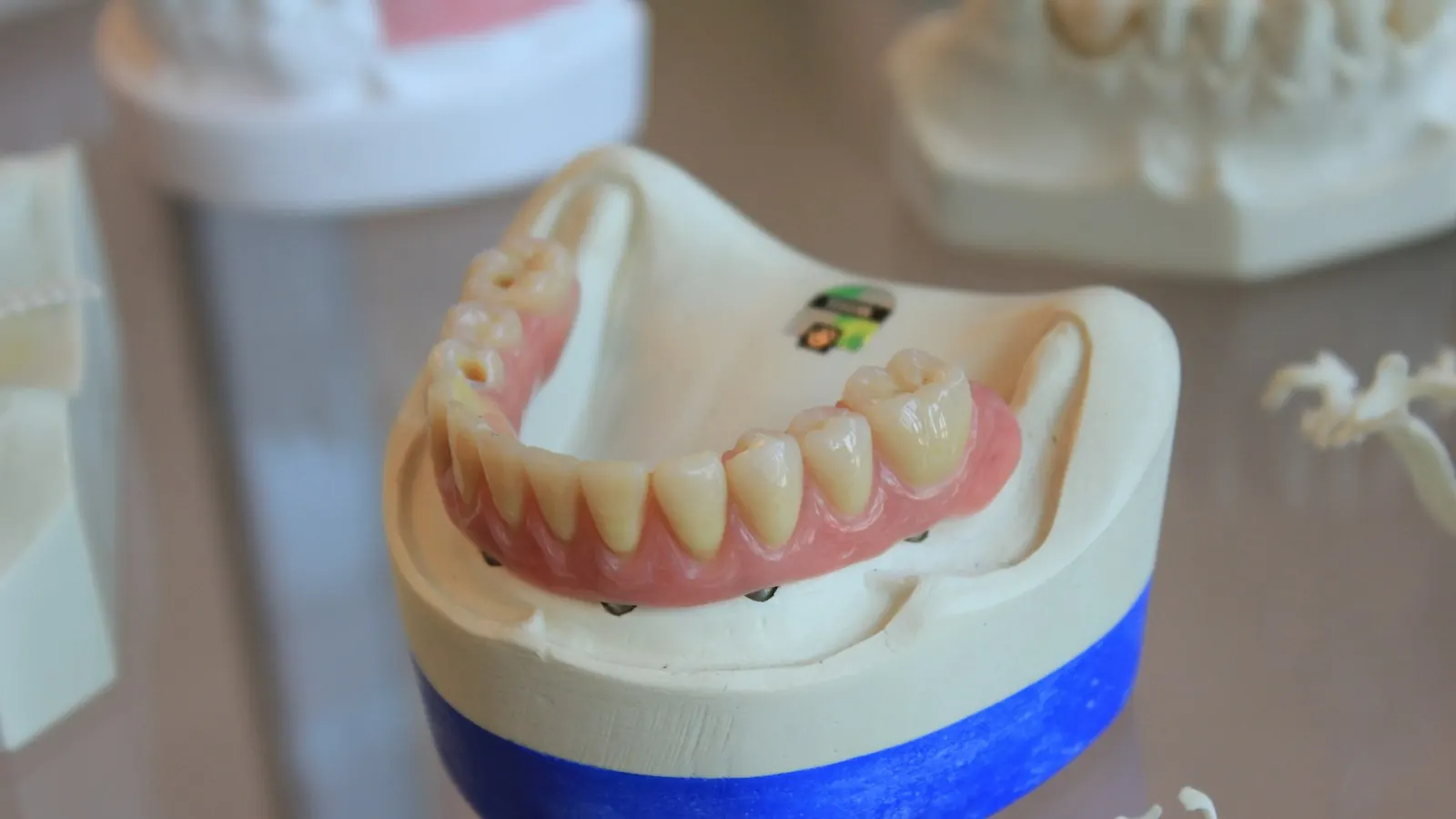
A full denture is made of a gum-coloured base with artificial teeth and is held by suction against the gums and palate. The upper denture is usually more stable because the palate gives a larger area to grip, while the lower denture moves more because the tongue moves it and the supporting area is smaller.
It is a simpler option with no surgery and suits people whose health or bone does not allow implants. An immediate denture may be fitted on the day of extraction so you are never without teeth, but it needs adjusting or relining once the gums heal and change shape over the first months.
Partial dentures: the options
A partial denture is used when some natural teeth remain. It rests on them with clasps and replaces the missing teeth in between. The main types are:
Acrylic dentures: simpler and quicker, sometimes used as a temporary solution, but bulkier and less stable.
Metal-framework dentures: thinner, stronger and more stable, spreading pressure better over the teeth and gums.
Flexible dentures: a soft base with gum-coloured clasps for a better appearance, but harder to adjust and reline, and not suitable for every case.
Your dentist chooses the type based on the number and position of remaining teeth and the health of their gums, and may suggest treating some teeth first so they make strong supports.
Implant-retained dentures and fixed teeth
For people bothered by a moving lower denture in particular, the denture can be secured on two or more implants with snap attachments (an overdenture). It still comes out for cleaning but is far more stable when eating and speaking, and it is one of the solutions that makes the biggest difference in comfort for people with a full lower denture.
Full fixed teeth are secured on more implants, often 4 to 6 per jaw, and are not removed by the patient; they are cleaned in place and unscrewed by the dentist for maintenance. They need enough bone, suitable general health and commitment to cleaning, and your dentist decides whether they suit you after a 3D scan and assessment.
How do you adapt to a new denture?
The first weeks are a learning period. It is normal for the denture to feel big, for saliva to increase and for some sounds to change slightly. With patience and practice this improves for most people:
Start with soft food cut into small pieces, and chew on both sides at once to keep the denture balanced.
Read aloud every day to help your speech adapt faster.
Avoid sticky and hard foods at first, and cut dates and meat into small pieces.
If a sore spot or ulcer appears, do not file the denture yourself; see your dentist to adjust it.
Use denture adhesive when needed and sparingly; constantly needing a lot usually means the denture needs adjusting.
Daily denture care
Take out a removable denture and rinse it with water after eating, and clean it thoroughly at least once a day with a denture brush and a denture cleaner or mild soap, as ordinary toothpaste can scratch its surface. Do not use very hot water, which can distort it, or household bleach.
It is usually advised to remove the denture at night and keep it in water or a special solution, to let the gums rest and reduce the risk of fungal infection. Clean your gums, tongue and any remaining teeth daily. Over time the bone and gums change shape, so the denture will need relining or replacing; see your dentist every year even if you have no natural teeth, for a check of the gums and whole mouth.
Frequently asked questions
How long does a denture last?
It depends on the type and care. Removable dentures usually need relining or replacing after some years because the bone and gums change over time. A poorly fitting denture can cause sores and speed up bone loss.
Can I eat everything with a denture?
Once adapted, most people eat most foods, but a removable denture chews less powerfully than natural teeth. Implant-retained dentures clearly improve chewing and stability.
Why does my denture become loose over time?
Because the bone under the gums gradually shrinks after teeth are lost, especially in the first years. Your dentist usually fixes this by relining or remaking the denture, and implants help slow the shrinkage.
Are implant-retained dentures suitable for older people?
Often, yes. There is no upper age limit as long as general health and bone allow it, and your dentist reviews medicines and chronic conditions before surgery.
When to see a doctor
See a dentist if your denture has become loose or moves when you eat or speak, causes sores or red gums, breaks or cracks, or if you notice cracks at the corners of your mouth, white patches or an ulcer that does not heal within two weeks. If you are considering a new denture or securing yours on implants, an assessment will clarify your options. You can book a consultation at Medical Care Clinics in Al-Shati Al-Gharbi, Dammam, close to Al-Khobar and Dhahran, where our dental team will examine your mouth and suggest the most suitable type of denture for you.
A crown is a cap that covers the whole tooth to protect it and restore its shape. Learn how zirconia, E.max and porcelain-fused-to-metal differ, and where each fits in the mouth.
If your teeth look longer than before or have become sensitive to cold, your gums may be receding. Learn the causes, the treatments and how to stop recession progressing.
Teeth can move at any age as long as the gums and bone are healthy. Learn what differs in adult orthodontics, the checks needed before starting, and how treatment fits into daily life.